


Life in the modern age makes people want to free themselves from mystery. Since the 17th century, humans have tried to understand the world with natural laws and rational logic. The world is no longer understood as a space full of symbols and meanings. This process is a process of demythologization. It is the process of separating myth from human consciousness. Since the demythologization process, the world feels neutral and mechanical. The world, which was previously full of meaning, becomes rigid and uprooted from its roots. Rational logic does bring progress, but it leaves a spiritual void.
People in modern times still need stories, symbols and imaginative experiences. These experiences are a bridge to meaning and critical thinking about life. Myths are a spiritual bridge between humans and the universe. This happens in many cultures in Indonesia including Bali and Sumba. Bali is rich in rituals, arts and performances. All are based on local mythology such as the Ramayana and stories of the gods. Balinese traditions are also rich in traditional ceremonies. Sumba has many similarities with Bali. In Sumba there is the Marapu tradition that emphasizes respect for ancestors. This tradition is deeply rooted. This tradition places ancestral stories as an integral part of children’s informal education. Myths and legends are passed down orally through the culture of storytelling. The culture of storytelling does not just convey knowledge, but also instills values, morals and a strong identity in the younger generation.
The diversity of oral traditions and literature is evidence of cultural richness. The richness that emerges through drama, dance, folklore, ceremonies and traditional gatherings is an inspiration for modern literacy education. Literacy should not only emphasize technical skills, but also strengthen meaning, empathy and imagination. Literacy becomes a means of strengthening character. Carl Jung and Joseph Campbell showed that myths are ‘inner maps’. Like Indonesian local stories in the context of reading literacy, myths lead students on a journey of the soul and a search for meaning.
In the modern and digital age, myths haven’t really disappeared. Humans still need stories to make sense of a complex world. Myths re-mythologize in the form of movies, social media, public figureand expressions of nationalism. New narratives are emerging, rapid change makes the future uncertain, but local roots remain important as the foundation of identity.
The above narrative is very relevant in the world of education, especially in the implementation of the Balanced Reading Program (PMB) for the early grades. PMB is a reading program that emphasizes meaning, not static and mechanical fluent reading. If reading learning only focuses on technical aspects such as letters, phonics, and fluency, there is a risk of neglecting the elements of meaning and imagination that are the main strengths of Indonesian speech culture. The Balanced Reading Program emphasizes the importance of a combination of basic reading skills and the ability to interpret and understand stories. Children are trained to be critical readers as well as connoisseurs of reading who are able to find the meaning of life in stories.
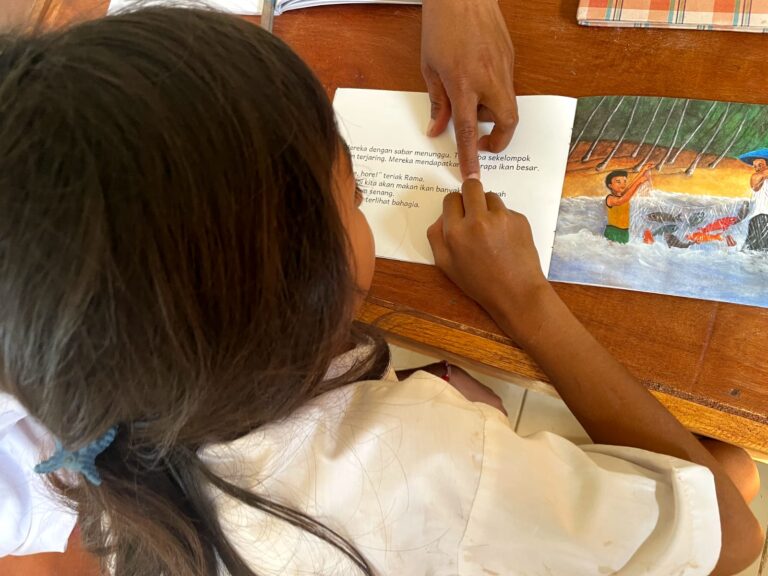
The rich storytelling culture of Indonesian society is the basis for the development of the Balanced Reading Program. This program makes activities come alive. A classroom rich in storytelling emerges. Through interactive reading, shared reading and independent reading activities, children are introduced to a variety of picture books designed to be relevant to their local daily lives. Books become windows, sliding doors and mirrors. The program also makes use of classroom reading corners and leveled books that promote differentiated learning. Discussion activities with deep and meaningful trigger questions foster children’s inquiry power.
With locality-infused innovations, children grow into global citizens without being uprooted from their roots. Literacy activities at YLAI involve contextual materials that reflect the richness of local values, customs and stories. Children not only learn to read technically, but also experience stories as a space to discover themselves, understand their environment, and expand their cultural horizons.